Relativistic Travel
Using Constant Acceleration
Time is not the same everywhere.
Einstein proved that when a clock accelerates, it runs more slowly compared to a clock that stayed behind. From the point of view of the stationary clock -- as you get closer to the speed of light, your own time becomes sluggish and starts to freeze.
The classic way to think about this is the twin paradox. Two identical twins on Earth start with synchronized watches. One boards a ship and accelerates away toward a distant star. After braking to a stop, the ship turns around and comes home. When they reunite, the traveling twin is young, fewer heartbeats, fewer birthdays even though the stay-at-home twin is now old and gray. This is the physics of Relativity, famously described in Heinlein's classic science fiction novel Time for the Stars. The effect was confirmed in 1971, when atomic clocks flown around the world aboard airliners returned measurably behind clocks that had stayed on the ground — the Hafele–Keating experiment.
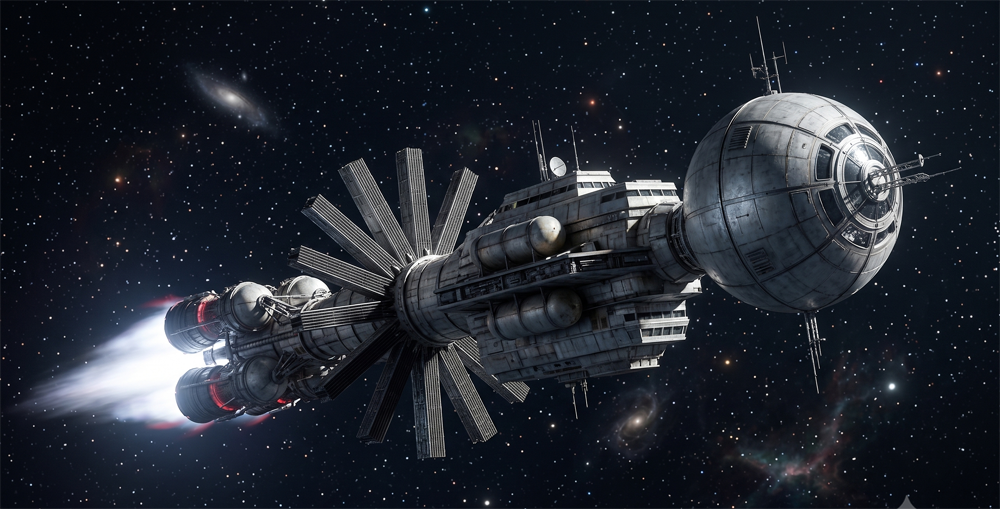
The calculator below assumes a nuclear torchship — an imagined vessel that can hold a steady acceleration. A ship that could sustain, say, one g of thrust indefinitely (9.8 m/s²) would give its crew comfortable Earth-normal gravity the whole voyage and reach relativistic speeds — the most humane and efficient way to cross interstellar distances, if we ever learn to build such an engine.
The standard profile is flip-and-burn -- accelerate for the first half of the distance, then rotate the ship 180° and decelerate for the second half, arriving at rest. For passengers the acceleration remains constant. Set a destination and an acceleration below, and watch the two clocks diverge: the ship time your crew actually lives through, and the Earth time that passes for everyone waiting at home.
These controls let you imagine what it would be like to take your own torchship journeys to the stars.